"Anish Kapoor's Memory Headed to New York's Guggenheim
Made of Cor-Ten steel, a new material for the artist, Memory measures a staggering 48 feet by 29 by 15.
Nicholas Tamarin -- Interior Design, 10/15/2009
Anish Kapoor Memory Guggenheim
“Memory” by Anish Kapoor, Cor-Ten steel, commissioned by Deutsche Bank in consultation with the Solomon R. Guggenheim Foundation for the Deutsche Guggenheim, Berlin Installation; Photo: Mathias Schormann © The Solomon R. Guggenheim Foundation
Having already conquered Chicago's Millennium Park and New York's Rockefeller Center, Anish Kapoor is turning his unique gaze toward the latter city's Guggenheim Museum, where his massive Memory sculpture debuts October 21.
On view through March 28 as part of the 50th anniversary of the Frank Lloyd Wright-designed museum, Memory is the first collaboration between the Guggenheim Foundation and the India-born, London-based artist. It comes to the city following a previous outing at Deutsche Guggenheim in Berlin.
Anish Kapoor Memory Guggenheim
“Memory” by Anish Kapoor, Cor-Ten steel, commissioned by Deutsche Bank in consultation with the Solomon R. Guggenheim Foundation for the Deutsche Guggenheim, Berlin Installation; Photo: Mathias Schormann © The Solomon R. Guggenheim Foundation
Working with Cor-Ten steel for the first time in his career, Kapoor formed a 24-ton, gallery-filling sculpture that measures 48 feet by 29 by 15, the scale and proportion complementing -- and perhaps challenging -- Lloyd's architectural masterpiece.
The work, so named for the processional manner in which it's viewed, can never be seen in its entirety. It divides the gallery space into several distinct viewing areas, including the museum's ramps, elevator banks, and an adjacent gallery.
Anish Kapoor Memory Guggenheim
Computer-generated image of “Memory” installed at the Solomon R. Guggenheim Museum; Image courtesy of Aerotrope Limited
Yet each vantage point offers only a glimpse of either the sculpture's exterior form or its interior shell, consisting of seamless 1/3-inch-thick steel tiles, only viewable through a 6 ½ wide aperture, which ensure absolute darkness inside. By viewing it in fragments, visitors are asked to connect and construct the images of Memory retained in their minds. Kapoor calls this process of increased exertion and effort in viewing art "mental sculpture."
AND AT THE TATE MODERN
Miroslaw Balka’s box of darkness is disturbing in its historical echoes but beautiful as well. The Times, "Miroslaw Balka's black hole at Tate Modern is terrifying, awe-inspiring and throught-provoking. It embraces you with a velvet chill."
The Guardian: "The latest commission in The Unilever Series, How It Is by Polish artist Miroslaw Balka, is a giant grey steel structure holding a vast dark chamber, which in its construction reflects the surrounding architecture of Tate Modern – almost as if the interior space of the Turbine Hall has been turned inside out. Hovering somewhere between sculpture and architecture, it sits on two-metre stilts and stands thirteen metres high and thirty metres long. Visitors can walk underneath it, listening to the echoing sound of footsteps on steel above, or enter via a ramp into its pitch-black interior."
Video of the installation here.
How It Is alludes to recent Polish history – for example, the ramp at the entrance to the Ghetto in Warsaw, or the trucks which took Jews away to the camps of Treblinka or Auschwitz. By entering the dark space, visitors place considerable trust in the organisation, something akin to the risks often taken by immigrants travelling. Balka intends to provide an experience for visitors which is both personal and collective, creating a range of sensory and emotional experiences through sound, contrasting light and shade, individual experience and awareness of others, perhaps provoking feelings of apprehension, excitement or intrigue."
Monday, October 19, 2009
Two New Installations That Make Me Feel Small But Think Big
Weschlers Results From Last Saturday

If the weather forecast holds we may see continued chilly wet days this weekend. Perfect for an auction in downtown DC. Adam A. Weschler & Son, Inc.
909 E Street, NW,Washington, D.C. is having a Fine Furniture and Decorations Sale this Saturday, the 17th starting at 10:00 a.m.
I normally give folks more time to peruse the pieces that caught my eye and have a look at the whole catalog but busy days have kept me from my duty. I did take a quick look and found a couple of pieces that appear to be nice buys. This will be a brown auction for Homer as almost everything I picked is old mahogany. However, take a look at the whole catalog. There are some fine rugs and silver and lots of things to entice the eye. This is also a great auction for those with Christmas in mind and that special gift you won't find in the department stores. Lets take a look.
I'm working Saturday at the Kellogg Collection, which is having a great upholstery sale, hint, hint, and won't be able to make the auction so everyone else have fun.
Federal Satinwood Inlaid Walnut Chest of Drawers
Mid-Atlantic States, Probably Maryland, Circa 1800
Having line inlaid drawers enclosed within a case with line inlaid canted corners and diamond-form, bone-inlaid escutcheons. Brasses replaced; some losses to inlay and drawer surrounds.
Height: 42-3/4 in (108.6 cm); Width: 41 in (104.1 cm); Depth: 19-1/4 in (48.9 cm)
Estimate $1,500-2,500. Every man should have one for his Stuff!
SOLD FOR $2,600.00
Chippendale Satinwood Inlaid Walnut Chest of Drawers
Mid-Atlantic States, Probably Winchester, VA, Circa 1780
Brasses replaced; lacking three locks.
Height: 41 in (104.1 cm); Width: 37-1/2 in (95.3 cm); Depth: 19-3/4 in (50.2 cm)
Estimate $1,200-1,800. I'm going to take a guess that this goes for much less. But still will look nice at home.
DID NOT SELL. NOT SURPRISED.
Set of Six Federal Mahogany Side Chairs
Probably New York, Circa 1815
Each with green upholstered slip seats. Each with veneer losses, particularly to the crest rail and seat rails; three with repairs to scrolled ears at crest rail.
Estimate $400-600. I'm sure a bit bruised, but for that price!
SOLD FOR $400.00. GUESS THEY WERE PRETTY BATTERED.
Neoclassical Style Carved Waxed Pine Hearth Surround
Probably English, Late 19th Century
Height: 58 in (147.3 cm); Width: 74 in (188 cm); Depth: 9-1/2 in (24.1 cm)
Estimate $1,000-1,500. I'd leave it just the way it is.
SOLD FOR $1,000.00. A STEAL..A STEAL! CAN YOU IMAGINE THE PRICE IN A RETAIL SETTING?
George III Style Satinwood Inlaid and Crossbanded Mahogany Linen Press
Circa 1900
In two parts with a removable cornice; the upper section with two panel doors opening to view three pull-out linen shelves. Brasses replaced; cornice possibly replaced; lacking one interior shelf.
Height: 79 in (200.7 cm); Width: 50 in (127 cm); Depth: 23 in (58.4 cm)
Estimate $2,000-4,000. Put a smallish flat screen in it for the bedroom.
SOLD FOR $1,500.00. A GREAT DEAL FOR FANCYING UP A ROOM.
George III Oak Refectory Table
Composed of 18th Century Elements
One end fitted with a frieze drawer.
Height: 32 in (81.3 cm); Length: 95 in (241.3 cm); Depth: 30 in (76.2 cm)
Estimate $1,500-2,500 . For the country style kitchen..hmmm.
$1,100.00. ANOTHER GREAT BUY. THIS WAS THE PIECE THAT REALLY INTERESTED THE EXPERTS AT WORK.
Louis Philippe Mahogany Trestle-Base Tric-Trac Table
Third Quarter 19th Century
The top having two slide-out panels opening to view a calamander and bois satiné game board which slides out to reveal a green felt backgammon board over a frieze drawer with green baize divided wells with turned light and dark wood game pieces.
Height: 30-1/2 in (77.5 cm); Width: 34-1/2 in (87.6 cm); Depth: 22-1/2 in (57.2 cm)
Estimate $2,000-3,000. I love classic games tables. A perfect way to while away a chilly fall night next to the fireplace, by candlelight of course.
DID NOT SELL. YET.
Sunday, October 18, 2009
R.I.P. Donald Kaufman, Toyland Loses A Great

Stephen Rose for the NYTimes
New York Times Obit:
October 18, 2009
Donald Kaufman, Collector of Toy Cars, Dies at 79
By DENNIS HEVESI
It started in 1950 with a $4 purchase from a friend: an International Harvester Red Baby truck. It grew into one of the largest and most valuable collections of antique toy cars and trucks in the world.
Donald Kaufman, whose trove included a highly prized 1912 Märklin live-steam fire engine before he began auctioning off his treasures in March, died on Monday at his home in Pittsfield, Mass. He was 79.
The cause was a heart attack, his wife, Sally, said.
More than 7,000 cars and trucks were parked bumper to bumper on the plain white shelves that Mr. Kaufman had bought at Home Depot and assembled himself, wall to wall and floor to ceiling, in the four-level annex to his modest country home in western Massachusetts. There were also airplanes and a smattering of other vintage toys.
His “toys” were only distantly related to the products, mostly made of plastic, that Mr. Kaufman had helped to sell over the years as vice president of the KB Toys store chain, from which he retired in 1981. Some of the pieces he owned, like the Märklin steam engine, were detailed works of art that actually worked.
Mr. Kaufman owned vehicles of all kinds: taxicabs (small, medium and large), old trucks bearing signs for brands from long ago (Richfield Gasoline, Filene’s Sons, Sheffield Farms Sealect), ice trucks, water trucks, dump trucks and fire engines. Mostly, they were made of cast iron, tin and pressed steel. A white, windup “Gordon Bennett” race car, made around 1910 by Guntherman in Germany, had a small bellows connected to the rear axle on the underside, so that it could still emit a rumble nearly a century after it was made.
“He owned almost every known variation of every known automotive toy,” said Richard Bertoia of Bertoia Auctions in Vineland, N.J., which is handling the sale of the Kaufman fleet. “Among collectors, he has been clearly declared the most important force this hobby has ever seen.”
In June, three months after the first in what is to be a series of auctions, Mr. Kaufman guided a reporter for The New York Times through what he and his wife called “the museum,” pointing out, however, that only about two dozen other people had ever been inside.
Asked why he was letting go of his beloved toys, he simply said, “It’s time for me to sell.”
And sell they have. At the first session, in March, about 1,400 of the 7,000 toys brought in $4.2 million, well above the $3 million that had been estimated. A three-foot-long train of hand-painted clown cars drew the highest price, $103,500.
At the second session, in September, about 1,100 toys were auctioned, bringing in approximately $3 million. The 1912 Märklin fire engine — 18 inches long, with an exposed boiler and intricate gear work in an open frame — drew the highest price, $149,500. Three more sessions are planned, the first next April.
Starting with that International Harvester Red Baby truck (it has not been sold yet, but is likely to go for a few hundred dollars), Mr. Kaufman spent much of his time over the last 59 years combing through antique stores, bidding in countless auctions and cultivating relationships with toy dealers. He and his wife spent vacations searching the market in Europe and attending nearly every toy show in the Northeast.
“These aren’t my toys,” Mr. Kaufman said in June. “I am just taking care of them.”
Donald Lewis Kaufman was born in Pittsfield on Oct. 8, 1930, one of three children of Harry and Ruth Klein Kaufman. In 1922, his father and uncle started a wholesale company, Kaufman Brothers, that distributed a variety of goods, including candy, soda, stuffed animals, watches and razors.
After attending North Adams State College in Massachusetts and serving in the Army in the early 1950s, Donald Kaufman joined the family business. In 1958, Kaufman Brothers expanded into retail. It became KB Toys in the 1960s and became entirely a retailing operation in 1972. As vice president, Mr. Kaufman played a role in expanding the chain to malls in almost every state. KB was sold to the Melville Corporation in 1981 and went out of business in 2008.
Mr. Kaufman’s first marriage, to the former Faith Dichter, ended in divorce. Besides his second wife, the former Sally Golden, he is survived by his sister, Joan Poultridge; three daughters from his first marriage, Suzanne Ascioti, Deborah Mager and Judith Wortzel; and four grandchildren from his first marriage. He is also survived by a stepson, Jack Roche; a stepdaughter, Mary Ellen Simon; and five step-grandchildren.
A deep fascination impelled Mr. Kaufman’s collecting.
“He didn’t just see a toy,” his wife said. “He would look at that toy and think about the history. He thought about what it was made of, the design, the people who sat there and made it. He would hold it and say, ‘If only it could talk.’ ”
Earlier this Year on Homer.
From the New York Times, yesterday, comes news of more toys!!
After a Life Selling Toys, It’s Time to Sell His Own
By RICHARD S. CHANG
Pittsfield, Mass.
WHEN Donald Kaufman decided that he wanted to sell his personal toy collection, an unparalleled trove of some 7,000 antiques from around the world, the news spread quickly among collectors. And it provoked the sort of market upheaval one might expect if the Getty Trust announced it was getting out of the art business.
“Nobody knew just how many toys he had,” said Jeanne Bertoia, the owner of Bertoia Auctions of Vineland, N.J., which is handling the sale. “People saw what he was buying, but no one had seen his collection.”
Part of the allure comes from Mr. Kaufman’s role as a co-founder of the defunct KB Toys store chain, from which he retired in 1981. He has given no reason for selling the collection he spent 59 years amassing, except for a nod toward destiny. “It’s time for me to sell,” he said.
In mid-March, Bertoia Auctions sold a portion of the collection, more than 1,400 toys, bringing in $4.2 million, well above the $3 million that Bertoia had estimated. (Mr. Kaufman’s estimate was $2 million.) Another auction is scheduled for September, after which Mr. Kaufman will still own more toys than he’ll have sold. Four to five more auctions are planned.
At 78, Mr. Kaufman is a tall man with a gentle grandfatherly manner that does little to reveal his ruthlessness in pursuit of pre-World War II toys. His approach to collecting combines erudition and gamesmanship. He enjoys telling the story of a particularly important sale. He rented a U-Haul trailer, hitched it to his capacious Ford Econoline van and parked the rig in front of the auction house as an act of intimidation against other potential buyers.
Transportation toys are Mr. Kaufman’s primary interest, and most pieces in the collection are cars and trucks. Airplanes are a distant third. The toys’ domain is a four-level windowless annex to the average-size country house here in western Massachusetts where Mr. Kaufman and his wife, Sally, live.
The Kaufmans call it “the museum,” though that makes it sound extravagant or grandiose, which undresses some of its charm. Mr. Kaufman assembled the displays himself. He bought plain white shelves at Home Depot and installed them himself. Entering the Kaufman museum, a visitor found antique toy cars parked bumper to bumper on shelves that ran wall to wall and floor to ceiling. There were taxicabs in small, medium and large. Old trucks bore signs for brands long gone: Richfield Gasoline, Filene’s Sons and Sheffield Farms Sealect. There were ice trucks, water trucks, dump trucks and fire engines. The floor — covered with carpet the color of blue topaz — was occupied by a small fleet of pedal cars.
“There are no duplicates,” Mr. Kaufman said proudly in a voice graveled by age. “Only variations.”
Some of the variations were so slight that it was difficult to see the differences. Along one stretch of wall, two red tow trucks were berthed nose-to-tail, one with round windows and the other with square ones. A line of four cast-iron taxicabs from the early 1920s provided an excellent exercise in observation — the only variations were in the color of the tires (silver and white) and hoods (orange and black). The March auction did little to decrease the jam in the museum, so there was not much room to move around.
Ms. Bertoia said the collection was divided into five categories: pedal cars; American cast-iron toys; tin toys, which are more delicate and mostly from Europe; pressed-steel toys; and light pressed-steel toys, including those from an American toymaker, Kingsbury.
“Usually you’d see between 25 and 30 toys in a good collection,” said Mike Bertoia, Ms. Bertoia’s son, of the Kingsburys. Mr. Kaufman, he said, has more than 150.
It takes a moment to see anything other than the sheer magnitude of the collection. Tighten the focus and intricate details emerge: the mechanical meter in a taxi, a hand-painted mustache on a driver, the brass fixtures of a fire engine’s water pump. The auction catalog showed that most were in very good, excellent, near-mint or pristine condition.
Sitting on a shelf along the staircase between the first and second floors, a white wind-up “Gordon Bennett” racecar made around 1910 by Guntherman of Germany hardly looked a century old. On the underside of the car was a small bellows connected to the rear axle, which Mr. Bertoia said still provided the car with engine noise. Another German toy, the Märklin Fidelitas, a whimsical three-foot-long train of delicate hand-painted clown cars, brought $103,500, the highest sale price at the first auction.
Mr. Kaufman likes to say that he wonders what the toys would say if they could talk. He explained that when he looked at an Arcade Mack high dump truck, he saw more than a toy vehicle. “I see the rubber factory that made the tires,” he said. “I see the metal factory, the press — the original cars.”
Born and raised in Pittsfield, Mr. Kaufman was always interested in antique cars and trucks. The first toy in his collection was an International Harvester Red Baby truck that he bought for $4 in 1950, the year he began working for the family business.
KB stands for Kaufman Brothers. Mr. Kaufman’s father and uncle founded the company in 1922 as a wholesaler. They carried goods as diverse as confections and sundries, sodas, razors, stuffed animals and watches, Mr. Kaufman said. Toys did not come along until after World War II.
In 1958, Kaufman Brothers expanded into retail, became KB Toys in the 1960s, and stopped wholesaling altogether in 1972. Mr. Kaufman does not boast about his role in the business, but he was the first vice president and had a hand in turning KB Toys into one of the biggest toy chains in the world, with hundreds of stores across the country.
Mr. Kaufman attended his first major auction shortly after he retired and found a community that welcomed his growing curiosity about antique toys. “I started talking to other collectors,” he said. “You learn everything from them.”
Mrs. Kaufman was not with her husband for that first auction — they met in 1988 — but she has been involved in his hobby since they have been together. A smartly dressed woman with short red hair who could draw comparisons to the actress Leslie Caron, she drove the van to many of the auctions and set up the vendor displays at toy shows for pieces that Mr. Kaufman wanted to sell.
Mrs. Kaufman told a story about one of her first experiences, when the collection of the closed Perelman Toy Museum in Philadelphia was being sold. The sale was held in the museum, and the buyers — each guaranteeing to spend at least $50,000 — had to race for the pieces they wanted.
She smiled and her eyes shone brightly as she told the story. And in many ways, the Kaufman collection is a diary of their lives together. The annex is a very private place. Mr. Kaufman said fewer than 25 people had been inside.
But if he is sad to see the collection go, he is not showing it.
He said he was not keeping a single toy, not even that first International Harvester Red Baby truck. “These aren’t my toys,” he said a couple of times during the day. “I am just taking care of them for now.”
But there are clues everywhere that the toys are more than just a passing interest. On the staircase between the first and second floors, Mrs. Kaufman pointed out a step ladder and two wooden planks.
“Don put those planks on top of the ladder and stood on them when he arranged the shelves above the stairs,” she said. She considered that thought for a moment, shook her head, smiling, and disappeared upstairs.
Saturday, October 17, 2009
Christie’s Sells $18.3 Million, Lures Buyers With Low Estimates

By Scott Reyburn
Oct. 17 (Bloomberg) -- Christie’s International last night attracted buyers with reduced estimates, selling all but one of just 25 contemporary artworks it selected for its London auction.
Christie’s total for the event, timed to coincide with the Frieze Art Fair, was 11.2 million pounds ($18.3 million), which included fees. This was almost double the presale low estimate of 6.8 million pounds, based on hammer prices. Three works sold for more than 1 million pounds, led by 2.3 million pounds for a Martin Kippenberger work. Half of the lots were bought by North American-based bidders, said the London-based auction house.
“There were some good things in the auction and estimates were reasonable,” said New York-based dealer Christophe van de Weghe. “It will give buyers confidence. People are able to see things are selling and there’s no panic in the market.”
The volume of sales at contemporary-art auctions dropped between 70 percent and 80 percent and the prices of works by 50 percent or more since the collapse of Lehman Brothers Holdings Inc. last September, said the London-based research company ArtTactic.
Christie’s equivalent auction last October, containing 47 lots, took 32 million pounds, against a lower valuation of 57.8 million pounds. Forty-five percent of the material failed to sell at that time. Christie’s, Sotheby’s and Phillips de Pury stopped guaranteeing minimum prices to sellers at the end of 2008. Collectors have been reluctant to offer high-priced works in public without guarantees; auction companies are selling more pieces through discreet private transactions, often for higher prices than they would have achieved under the hammer.
Big Frieze
“Frieze is a big week in London,” said Francis Outred, Christie’s European head of contemporary art. “We wanted to get the right property at the right price. There were a few come-on estimates that attracted a good mixture of bargain hunters and big-game hunters,” he said.
A 2004 Rudolf Stingel silver wallpaper painting that failed to sell at Christie’s London in February 2008 against a low estimate of 500,000 pounds was re-offered last night at 150,000 pounds to 200,000 pounds. A flurry of bidding pushed the price up to 289,250 pounds.
“Prices are back to the level of 2006 and 2007,” said Van de Weghe.
Kippenberger’s 1991 painting, “Paris Bar,” sold to a telephone buyer, with New York dealer Tony Shafrazi the underbidder. The 13-foot-wide depiction of the Berlin bar that was once frequented by himself, David Bowie, Iggy Pop and Andy Warhol was entered by a European collector and had never been offered at auction before. The artist died in 1997, aged 44.
Pop Life
Another version of the same subject by the artist’s contemporary, Daniel Richter, is currently on show in the “Pop Life” exhibition at Tate Modern. At least six bidders contested the painting, which was estimated at 800,000 pounds to 1.2 million pounds. New York dealer Jeffrey Deitch paid a further 1.1 million pounds, double the low estimate, for Kippenberger’s 1991 panel painting of a street mounted with wall lights, “Kellner Des... (Waiter Of...)”
Peter Doig’s 1994 canvas “Pine House (Rooms for Rent)” was another re-offer, having failed to achieve its low estimate of $4.5 million at Christie’s New York in November, when it was guaranteed. Now owned in whole or part by the auction house, it sold to a lone telephone bid of 1.4 million pounds against a revised estimate of 1.5 million pounds to 2 million pounds.
Signal Box
The sale’s other main success was the double-estimate -- and record -- 892,450 pounds paid for “Stellwerk” (Signal Box), a 1999 painting by Leipzig School artist Neo Rauch.
Christies will be offering 145 lots of “Part II” quality material today with a low estimate of 2.9 million pounds.
Earlier yesterday, Sotheby’s held a 217-lot auction of contemporary art that combined its “Part I” and “Part II” quality material, bolstered by a section of Arab and Iranian works. The event achieved a total of a mid-estimate 12.8 million pounds, with 73 percent of the pieces finding buyers.
Jean-Michel Basquiat’s 1983 acrylic and oilstick painting “Fuego Flores” was the most expensive lot, selling to a telephone bidder for 959,650 pounds against a high estimate of 1.2 million pounds. The 5-foot-6-inch-high painting, featuring a half-length figure with one of Basquiat’s trademark skull faces, had recently been authenticated by the artist’s estate. Two slightly larger paintings by Basquiat from 1982 fetched 6.5 million pounds and $13.5 million at auctions in London and New York last year.
Damien Hirst’s pale-blue-and-white 2006 circular butterfly painting “Retribution” sold to the New York collector Jose Mugrabi for 541,250 pounds against an estimate of 450,000 pounds to 650,000 pounds.
Hirst Incarnate
The 6-foot-8-inch-diameter household-gloss-on-canvas was a similar size as, and a similar color to, the 2008 butterfly work “Reincarnated,” which had a low valuation of 500,000 pounds at the company’s “Beautiful Inside My Head Forever” sale last September. That work went on to fetch 1.6 million pounds with fees. The ArtTactic Average Price Index for Hirst butterfly paintings has dropped 41 percent since September 2008, said the research company’s founder Anders Petterson.
“It’s very difficult to value things at the moment,” said the New York-based art adviser David Nisinson, who bought a 1990 Gerhard Richter abstract for 529,250 pounds at Sotheby’s against a low estimate of 500,000 pounds. “So little has been traded recently that it’s hard to know what things are worth. It’s a market in flux. There’s more confidence than there was, but it’s fragile and depends on the financial markets. At least a lot of people have a lot more money than they did six months ago,” he said.
Kapoor Mirror
An 8-foot-diameter Anish Kapoor stainless-steel-mirror sculpture, dating from 1997, sold to a telephone bidder for 825,250 pounds against an estimate of 600,000 pounds to 800,000 pounds. The sculpture had been acquired from London’s Lisson Gallery, which has just sold a new 4-foot-diameter Kapoor mirror piece, this time in gold, priced at 475,000 pounds at the Frieze Art Fair.
For the first time, Christie’s and Sotheby’s also held their October auctions of 20th-century Italian works on the same day as their contemporary-art sales. Christie’s took 5.8 million pounds from 37 lots, while Sotheby’s achieved 7.4 million pounds from 33 lots of Italian material.
Sotheby’s sales included nine works donated by artists to benefit Harefield Hospital, a unit on the outskirts of London specializing in cardiac surgery. The auction was the idea of surgeon Jullien Gaer, who invited artists to visit the hospital.
Grayson Perry’s glazed ceramic “Urn for the Living,” depicting surgeons around a gaping hole in the body of the pot, was inspired by observation of an open-heart operation. It sold for a hammer price of 48,000 pounds, near to the top estimate of 50,000 pounds. The section generated a total of 485,000 pounds for the hospital.
(Scott Reyburn writes about the art market for Bloomberg News. Opinions expressed are his own.)
To contact the writer on the story: Scott Reyburn in London at sreyburn@hotmail.com
Wednesday, October 14, 2009
Auction Results From The Estate of William F. Reilly

The auction total came to a Sale Total: $6,523,312 (U.S. dollars). Quality retains its value. Take a look.
I was stunned by the beauty of this collection and picked but a few things that really caught my eye. Most are very expensive but there are a couple of pieces that while truly great looking are within the reach of this shanty Irishman, or you should you be so tempted. The full catalogue is here and will have you salivating at his good taste.
A FRENCH CUIR BOUILLE PORTRAIT OF LOUIS XIV
AFTER FRANCOIS GIRARDON, EARLY 18TH CENTURY, THE FRAME SECOND QUARTER 18TH CENTURY
Depicted in profile, wearing armor, within a Louis XV giltwood frame with partial printed paper label for CH. POTTIER EMBALLAMEUR-PACKER/PARIS, and with a further paper label with painted '2919', the leather rebacked
28 in. (71 cm.) high, 22½ in. (57 cm.) wide (the portrait), 36 in. (91.5 cm.) high, 30½ in. (77.5 cm.) wide, overall
$20,000.00 - $30,000.00
SOLD FOR $37,500.00
A DIRECTOIRE ORMOLU BOUILLOTTE LAMP
LATE 18TH CENTURY
With a green tôle shade and pierced circular base, shade redecorated, electrified
26 in. (66 cm.) high, overall
$7,000.00- $10,000.00
SOLD FOR $5,250.00. STILL, ONE EXPENSIVE LAMP.
A PAIR OF TOLE PEINTE LEMON TREES
20TH CENTURY
23½in. (59.5cm.) high (2)
$600.00 - $800.00
SOLD FOR $4,375.00. OH MY GOSH!
A PAIR OF GEORGE II GILTWOOD DOLPHIN-FORM WALL CARVINGS
MID-18TH CENTURY
Each grimacing dolphin with upright scrolling tail
33 in. (83.8 cm.) high (2)
$20,000.00 - $40,000.00
SOLD FOR $50,000.00. THOSE DOLPHINS AREN'T GRIMACING TONIGHT.
A PAIR OF GILT-METAL TABLE LAMPS
20TH CENTURY
Each stem in the form of an armilliary sphere
12 in. (31 cm.) high (2)
$700.00 - $900.00
SOLD FOR $30,000.00. I CHECKED! AND DOUBLE CHECKED, THAT'S WHAT IT SAYS!!!
A COLOSSAL ROMAN MARBLE PORTRAIT HEAD OF THE EMPEROR TRAJAN
REIGN 98-117 A.D.
His long wavy locks combed forward over the crown of the head, their pointed tips curving left across the forehead, the locks defined by deep drill-work and incision, the large almond-shaped eyes framed by thick lids, the inner canthi deeply drilled, the modelled brows overhanging the inner corners of the eyes, with vertical furrows above the nose, the thin lips pursed, the outer corners slightly downturned and framed by pronounced nasolabial folds, the muscular neck rippled from the slight turn to his left
19½ in. (49.5 cm.) high
$100,000.00 - $150,000.00
SOLD FOR $146,500.00. RIGHT ON THE MONEY. OF COURSE ST. LAURENT IS DEAD.
A PAIR OF BLACK-PATINATED BRONZE MODELS OF THE WARWICK VASE
19TH CENTURY
With masks and loop handles, on a square red marble plinth
18½ in. (47 cm.) high, 16 in. (40.6 cm.) wide (2)
$7,000.00 - $10,000.00
SOLD FOR $6,000.00. NOW THERE WAS A DEAL.
AN ATTIC BLACK-FIGURED AMPHORA
CIRCA 540-530 B.C.
The obverse with a nude youth on horseback in profile to the right, riding one horse and leading a second horse beside, both horses with their heads lowered, flanked by two large draped youths, a fillet in the field; the reverse with a nude youth on horseback; alternating red and black tongues above, a lotus and palmette quatrefoil on the neck, details in added red
14¾ in. (37.5 cm.) high
$20,000.00 - $30,000.00
SOLD FOR $32,500.00
AN IRISH GEORGE III MAHOGANY HUNT TABLE
LATE 18TH CENTURY
The hinged oval top above double gatelegs
29 in. (73.5 cm) high, 101½ in. (258 cm.) wide, 57 in. (145 cm.) deep
$30,000.00 - $50,000.00. Dont'ya love Irish furniture.
DID NOT SELL
A PAIR OF IRISH GEORGE III BRASS-BOUND MAHOGANY BUCKETS
LATE 18TH CENTURY
Each with engraved brass banding, bail handle and removable brass liner
17 in. (43 cm.) high, 15½ in. (39.5 cm.) diameter (2)
$15,000.00 - $25,000.00. Wow what a way to serve Guinness.
SOLD FOR $17, 500.00
A VICTORIAN BLACK, GOLD AND RED JAPANNED PAPIER MACHE GLOVE BOX
LATE 19TH CENTURY
Decorated with figural cartouches
8¾ in. (22 cm.) wide
$400.00 - $600.00
SOLD FOR $1,250.00
A FRENCH PATINATED WROUGHT-IRON AND GLASS LOW TABLE
MODERN
Rectangular, on curule frame
$1,000.00 - $1,500.00. That's the piece I want!!! So we'll see how much it goes for with great interest.
SOLD FOR $625.00. DAGNABBIT!!!**** THERE WAS A DEAL!!!
A GEORGE II BLACK-AND-GILT JAPANNED LINEN PRESS
ATTRIBUTED TO GILES GRENDEY, CIRCA 1740
The dentil-carved cornice above cartouche-paneled doors and two short over a long drawer on ogee bracket feet, decorated throughout with Chinoiserie vignettes and animals, pulls and locks later, refreshments to decoration
$80,000.00 - $120,000.00
SOLD FOR $134,500.00. SUCH A PRETTY PIECE
A LATE GEORGE III MAHOGANY THREE-TIER WHATNOT
LATE 18TH CENTURY
Square, with a mahogany-lined medial drawer
$4,000.00 - $6,000.00
SOLD FOR $3,750.00. VERY FAIR
AN IRISH GEORGE II MAHOGANY SERVING-TABLE
CIRCA 1760
The shaped top pierced with quartrefoils over a fluted and paterae-carved frieze on molded legs with guttae feet
$20,000 - $30,000.00
SOLD FOR $27,500.00
Tuesday, October 13, 2009
I Want One

A Continous Lean says they're good and that's enough of an endorsement for me. I love a great shirt. A bit pricey, though made in America.Hamilton 1883.
The World's 13 Ugliest Buildings

Fun look at some atrocious buildings from Travel and Leisure, if you have a few minutes. The link is here.
Monday, October 12, 2009
My Next Day Off

Past readers know I love portraits so here's an event I look forward to seeing in DC.
Now at the National Gallery of Art
Robert Bergman: Portraits, 1986–1995
October 11, 2009–January 10, 2010
NGA:"For more than 40 years, Robert Bergman (b. 1944) has traveled the streets and back alleys of the United States, photographing the people and scenes he encounters. Beginning in the 1960s, he, like so many other so-called street photographers of that generation, used a 35mm camera to make black-and-white photographs. In the 1980s Bergman began to work in color. Using no special lighting or equipment, he made a series of monumental portraits of the people he met. The exhibition will present 33 of these compelling portraits from a recent gift to the Gallery of more than 90 photographs by Bergman, most of which have never before been exhibited."
Thursday, October 8, 2009
More News On The William F. Reilly Auction

Flemish artist active in Northern Italy, 16th Century - identified as the Monogrammist 'MO', A view of a villa with acrobats and gentlefolk, signed with monogram and dated 'M D/LXVI' on pedestal (lower left) oil on canvas, 67¼ x 93 in. (170.8 x 236.2 cm.) Estimate: $600,000 - 800,000. Photo: Christie's Images Ltd 2009.
NEW YORK, NY.- This October, Christie's presents a special collection of fine art and furnishings from the Manhattan residence of the late Mr. William F. Reilly, a prominent philanthropist, collector, and former chief executive officer and chairman of the publishing firm Primedia.Full catalogue here. This superb collection of important 18th and 19th century furniture, rare antiquities, Old Master paintings, and decorative items was primarily housed in Mr. Reilly's Sutton Square townhouse, located in one of Manhattan's most fashionable neighborhoods. The three-story house with its dramatic river views and impeccably-designed interiors has been profiled in House & Garden and Architectural Digest, among other publications. The complete collection of over 230 items is expected to realize in excess of $5 million.
To build the collection, the late Mr. Reilly worked with top New York antiques consultant and interior designer Timothy Whealon. Over the course of 12 years, Whealon scoured auction houses, dealers, antiques fairs, and art galleries to create a refined collection of rare works of art and antiques. For the sale preview, Christie's will re-assemble the bulk of the collection just as it appeared in the main rooms of Mr. Reilly's home, even using a similar color palette as the one that Whealon chose for the walls.
"The overall design aesthetic was conceived as a modern take on the great English country houses," said Whealon. "Mr. Reilly was an educated connoisseur with a deep interest in European history and the classics. To reflect that, we grounded the collection with excellent examples of English, Irish, and Continental furniture and complimented them with Greek and Roman antiquities, and paintings by the early 18th century Italian masters. Modernist touches in the form of lamps, occasional tables, and small decorative items kept the whole looking fresh and relevant, and remarkably easy for someone to live with."
Exceptional Provenance
The Reilly collection is highlighted by several extraordinary furnishings from prominent British houses, including a Regency Ormolu and Black Slate Mantel Clock, no. 538 (estimate: $40,000-60,000) by Benjamin Lewis Vulliamy, London’s pre-eminent luxury goods producer in the early 19th century. The clock was ordered by the Prince of Wales for his Royal residence at Carlton House, St. James’s, London and delivered in 1815. A George III Mahogany Cabinet-On- Chest (estimate: $200,000-400,000) features an arched cornice, paneled doors and four graduated drawers accented with carved ionic columns and a Greek key design on the façade. This extraordinary 18th century cabinet bears the penciled signature of William Hallett, one of the most well-regarded cabinetmakers to England’s royal families. It is believed this magnificent cabinet was commissioned by Sir Charles Kerneys Tynte, 5th Baronet, for Halswell Park, Bridgwater, Somerset.
From Hamilton Palace, the largest and most majestic of Scotland’s country houses, comes a pair of English Ormolu-Mounted Satinwood-Inlaid Walnut Stools (estimate: $60,000-100,000) that were once part an extensive marquetry suite. Based on inventories of palace furnishings, it is believed that one stool dates from the original suite that was likely commissioned by James Hamilton, 4th Duke of Hamilton, or by his son James, circa 1710-1720. The second stool was likely commissioned in the early 19th century by the 10th Duke to extend the suite. In later years, the pair was purchased by Sunlight Soap magnate William Lever, the 1st Viscount Leverhulme, and became part of his storied collection at The Hill, his residence in Hampstead.
A pair of George II Walnut and Figured Walnut Open-Armchairs from circa 1730 (estimate: $250,000-400,000) bears the ducal coronet of the Astley family, and are part of a set believed to have been ordered by Sir Phillip Astley, 2nd Baronet (d.1739) or his son Sir Jacob Astley, 3rd Baronet (d. 1760). A Regency Brass-Mounted Ebonized and Specimen Marble Side Table (estimate: $70,000-100,000) features a top veneered with a grid of multi-colored Italian marble specimens. This unique table from circa 1800 is believed to have been acquired on the Grand Tour by the notable art patron and connoisseur Edward, Viscount Lascelles (d. 1814).
Among the excellent examples of Continental furniture in the collection is a Pair of Italian Giltwood Side Tables (estimate: $150,000-250,000) made in Rome circa 1775 in the manner of the influential architect and designer Giovanni Battista Piranesi (1720-1778). These exquisite tables with their unique curved legs and medallion friezes are similar to those formerly housed in the Palazzo Rezzonico and Palazzo Borghese.
Antiquities
Mr. Reilly’s deep knowledge of Roman history fueled the acquisition of several important antiquities for his collection, led by a Roman Marble Portrait Head of the Emperor Antoninus Pius (estimate: $400,000-600,000), who became emperor at the age of 52, and reigned from 138-161 A.D. – a period of relative calm, security, and religious piety in the Roman empire. Other portraits in the collection include a Colossal Roman Marble Portrait Head of the Emperor Trajan (estimate: $100,000-150,000) who reigned from 98-117 A.D., and a Roman Marble Portrait Head of the Youthful Marcus Aurelius, circa 138 A.D. (estimate: $150,000-250,000). The latter was one of the first purchases Mr. Reilly made as a collector; he had such high regard for the celebrated young emperor that he named his company Aurelian Communications upon its founding in 2001.
Perhaps the most dramatic item to feature in the Reilly collection is a Greek Marble torso of the goddess Aphrodite (estimate: $200,000-300,000) from the Hellenistic period, circa 1st century B.C. Nearly two-thirds life sized, the partially-draped torso stands with left knee bent and right hip thrust at an angle, forming a sensuous pose.
Old Master Paintings
Leading the collection’s offering of Old Master paintings is a massive 16th century festival scene by a Flemish artist known only as the Monogrammist ‘MO’. Populated with scores of brightly costumed acrobats, A view of a villa with acrobats and gentlefolk; estimate: $600,000-800,000) is a sweeping, jubilant scene of a court festival on the grounds of an Italianate villa. As elegantly dressed courtiers look on, troupes of acrobats in red jumpsuits and ancient military uniform perform elaborate dances and complicated balancing acts. This vibrant celebratory scene, which measures nearly eight feet wide, was the focal point of the dining room at Reilly’s Sutton Square home.
Two important Italian Old Master landscapes from the living room of the Reilly home will be offered as highlights of the Important Old Masters and 19th Century Art sale on January 27, 2010: View of Piazza del Popolo, Rome (estimate: $600,000-800,000) by Giovanni Paolo Panini (1691/2-1765) and Extensive Landscape with Figures at a Shrine (estimate: $300,000-500,000), a rare collaboration between Alessandro Magnasco, Il Lissandrino (1667-1749) and Antonio Francesco Peruzzini (1643/46-1724).
Decorative Highlights
A devoted collector of Irish as well as English furnishings, Mr. Reilly’s collection is highlighted by an exceedingly rare example of Dublin scagliola inlay work attributed to Pietro Bossi, the most accomplished artisan working in Dublin towards the end of the 18th century. This Irish George III White Marble and Scagliola Chimneypiece; estimate: $100,000-150,000) is accented with beautifully-drawn leaf work and ribbon-hung Etruscan medallions in vivid hues of red, blue and green that remain remarkably unfaded. Less than 50 chimney pieces of this type are believed to have been created, and only two or three pieces of comparable quality have appeared on the market in recent years.
Among the more whimsical items within the Reilly collection is a Pair of George II Giltwood Dolphin-Form Wall Carvings from the mid-18th century (estimate: $20,000-40,000). These grimacing fish-like figures with scrolling tails once adorned the Sutton Place apartment of Marietta Tree, the New York society doyenne. They are believed to have been purchased initially by Nancy Lancaster, the legendary designer (and the first Mrs. Ronald Tree), for Ditchley Park in Oxfordshire, one of England’s greatest country houses.
Rounding out the selection of decorative accents is a large selection of mirrors from a variety of periods and styles, including a Louis XIV Ormulu-Mounted Boulle Marquetry Mirror from circa 1710 (estimate: $60,000-100,000); and a pair of five-foot high English Giltwood Mirrors (estimate: $60,000-90,000), one George II, circa 1740, and the other created to match by Carvers and Gilders of London. Also among the offerings is a selection of English silver, including salvers, salt cellars, utensils, and a complete coffee and tea service (estimates range: $500-35,000); and an array of blue and white Chinese export porcelain items, including vases, plates, and urns from the Kangxi period (estimates range: $3,000-30,000)
As another Irish American who has benefited from coming to these shores, I was astounded by the completely beautiful eye that Mr. William F. Reilly had in acquiring some the of finest pieces I've ever seen.Christies is offering a large number of pieces from his estate on October 13th 2009.
From Quogue News: "William F. Reilly passed away last year at the young age of 70. He lived in Quogue and Manhattan.He was the former chief executive officer and chairman of Primedia,and he was a successful media executive, philanthropist, collector, veteran.
Mr. Reilly began his career as a financial analyst and assistant to Peter Grace, the chairman and CEO of W.R. Grace & Co. and was appointed president and CEO of the company’s textile, sporting goods, and home products divisions. Following his tenure with the company, Mr. Reilly become the president of Macmillan Inc., and was significantly involved in the company’s greatest period of growth in its 50-plus-year history.
After losing a battle to stave off a takeover of Macmillan by Robert Maxwell in 1989, Mr. Reilly co-founded, and became chairman and CEO of, what was to become Primedia, whose media properties included New York and Seventeen magazines and 200 other properties.
After leaving Primedia, he became a successful private equity investor in partnership with Providence Equity Partners, and most recently with Summit Business Media in partnership with Wind Point Partners.
In his commitment to helping the New York City community, his priorities were education and other philanthropic endeavors. He was a member of the board of trustees of Channel 13/WNET and Citymeals-on-Wheels and adopted Cardinal Hayes High School, where he funded the technology lab and raised millions for its benefit while mentoring individual students who showed great promise in potential business careers.
As an alumnus of Notre Dame University, Mr. Reilly was an active member on the board of trustees of the university and a member of its executive committee. He also drew on his publishing expertise as a member of the Harvard Business School Press board of directors.
With his great love and knowledge of history and the decorative arts, he collected Greek and Roman antiquities and English furniture. He had a passion for classical architecture and owned and restored an 1830 historic home in Quogue and a townhouse on Sutton Square in Manhattan. He enjoyed traveling in Europe, studying classical architecture and acquiring items for his homes. He also served as a first lieutenant in the 82nd Airborne Division of the United States Army.
Mr. Reilly was on the board of directors of Barnes and Noble, FMC, and BizBash Media. He was also the chairman of Summit Business Media and hosted the Swing Into Summer Southampton Hospital benefit for many years."
I found this video on youtube which must have been made by a family member as a tribute to him. It has no sound due to some copyright problems but still shows a man who lived well and was obviously loved by many.Video
I was stunned by the beauty of his collecting and picked but a few things that really caught my eye. Most are very expensive but there are a couple of pieces that while truly great looking are within the reach of this shanty Irishman or you should you be so tempted. The full catalogue is here and will have you salivating at his good taste.
A FRENCH CUIR BOUILLE PORTRAIT OF LOUIS XIV
AFTER FRANCOIS GIRARDON, EARLY 18TH CENTURY, THE FRAME SECOND QUARTER 18TH CENTURY
Depicted in profile, wearing armor, within a Louis XV giltwood frame with partial printed paper label for CH. POTTIER EMBALLAMEUR-PACKER/PARIS, and with a further paper label with painted '2919', the leather rebacked
28 in. (71 cm.) high, 22½ in. (57 cm.) wide (the portrait), 36 in. (91.5 cm.) high, 30½ in. (77.5 cm.) wide, overall
$20,000.00 - $30,000.00
A DIRECTOIRE ORMOLU BOUILLOTTE LAMP
LATE 18TH CENTURY
With a green tôle shade and pierced circular base, shade redecorated, electrified
26 in. (66 cm.) high, overall
$7,000.00- $10,000.00
A PAIR OF TOLE PEINTE LEMON TREES
20TH CENTURY
23½in. (59.5cm.) high (2)
$600.00 - $800.00
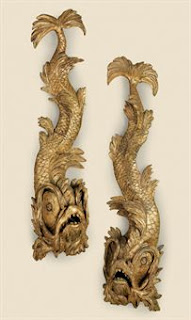
A PAIR OF GEORGE II GILTWOOD DOLPHIN-FORM WALL CARVINGS
MID-18TH CENTURY
Each grimacing dolphin with upright scrolling tail
33 in. (83.8 cm.) high (2)
$20,000.00 - $40,000.00
A PAIR OF GILT-METAL TABLE LAMPS
20TH CENTURY
Each stem in the form of an armilliary sphere
12 in. (31 cm.) high (2)
$700.00 - $900.00
A COLOSSAL ROMAN MARBLE PORTRAIT HEAD OF THE EMPEROR TRAJAN
REIGN 98-117 A.D.
His long wavy locks combed forward over the crown of the head, their pointed tips curving left across the forehead, the locks defined by deep drill-work and incision, the large almond-shaped eyes framed by thick lids, the inner canthi deeply drilled, the modelled brows overhanging the inner corners of the eyes, with vertical furrows above the nose, the thin lips pursed, the outer corners slightly downturned and framed by pronounced nasolabial folds, the muscular neck rippled from the slight turn to his left
19½ in. (49.5 cm.) high
$100,000.00 - $150,000.00
A PAIR OF BLACK-PATINATED BRONZE MODELS OF THE WARWICK VASE
19TH CENTURY
With masks and loop handles, on a square red marble plinth
18½ in. (47 cm.) high, 16 in. (40.6 cm.) wide (2)
$7,000.00 - $10,000.00
AN ATTIC BLACK-FIGURED AMPHORA
CIRCA 540-530 B.C.
The obverse with a nude youth on horseback in profile to the right, riding one horse and leading a second horse beside, both horses with their heads lowered, flanked by two large draped youths, a fillet in the field; the reverse with a nude youth on horseback; alternating red and black tongues above, a lotus and palmette quatrefoil on the neck, details in added red
14¾ in. (37.5 cm.) high
$20,000.00 - $30,000.00
AN IRISH GEORGE III MAHOGANY HUNT TABLE
LATE 18TH CENTURY
The hinged oval top above double gatelegs
29 in. (73.5 cm) high, 101½ in. (258 cm.) wide, 57 in. (145 cm.) deep
$30,000.00 - $50,000.00. Dont'ya love Irish furniture.
A PAIR OF IRISH GEORGE III BRASS-BOUND MAHOGANY BUCKETS
LATE 18TH CENTURY
Each with engraved brass banding, bail handle and removable brass liner
17 in. (43 cm.) high, 15½ in. (39.5 cm.) diameter (2)
$15,000.00 - $25,000.00. Wow what a way to serve Guiness.
A VICTORIAN BLACK, GOLD AND RED JAPANNED PAPIER MACHE GLOVE BOX
LATE 19TH CENTURY
Decorated with figural cartouches
8¾ in. (22 cm.) wide
$400.00 - $600.00
A FRENCH PATINATED WROUGHT-IRON AND GLASS LOW TABLE
MODERN
Rectangular, on curule frame
$1,000.00 - $1,500.00. That's the piece I want!!! So we'll see how much it goes for with great interest.
A GEORGE II BLACK-AND-GILT JAPANNED LINEN PRESS
ATTRIBUTED TO GILES GRENDEY, CIRCA 1740
The dentil-carved cornice above cartouche-paneled doors and two short over a long drawer on ogee bracket feet, decorated throughout with Chinoiserie vignettes and animals, pulls and locks later, refreshments to decoration
$80,000.00 - $120,000.00
A LATE GEORGE III MAHOGANY THREE-TIER WHATNOT
LATE 18TH CENTURY
Square, with a mahogany-lined medial drawer
$4,000.00 - $6,000.00
AN IRISH GEORGE II MAHOGANY SERVING-TABLE
CIRCA 1760
The shaped top pierced with quartrefoils over a fluted and paterae-carved frieze on molded legs with guttae feet
$20,000 - $30,000.00
Saturday, October 3, 2009
Auction houses become private dealers as power shifts from seller to buyer
Tom Flynn: Art Knows:
Tuesday, September 29, 2009
Auction houses become private dealers as power shifts from seller to buyer
The steady transformation of the big international fine art auction houses into private dealerships continues apace. The process has been going on for some time with the acquisition by auction houses of leading dealerships in the fields of Old Masters and Contemporary Art. But the fall of Lehman Brothers last year has punched a hole the size of the Grand Canyon into vendor consignments, forcing the auctioneers into conducting more and more private transactions. How this will affect the future of art price databases, which rely on the steady availability of public auction prices?
This morning, Bloomberg calculates that the forthcoming London contemporary art auctions, to be held by Christie's and Phillips de Pury during the week of the Frieze fair, are estimated to realise £20.8 million ($33.1 million). That contrasts with the equivalent sales last year, which carried a low estimate of £107 million, in other words around 80% down.
But interestingly, Bloomberg also reports that private sales transacted by Christie's outstripped its auction sales in the first half of 2009. "Christie’s had £133.1 million in private sales in the first half of 2009," writes Bloomberg's Scott Reyburn.
An artist friend asked me recently why Christie's had bought the London dealership Haunch of Venison. There's the answer. Foreseeing the imminent decline of the public auction market and knowing the extent to which buyers and sellers privilege discretion over transparency, the auction houses have steadily strengthened their foothold in the lucrative private sales arena. The risks of consigning works to public auction have multiplied in just a matter of months. The discreet private alternative starts to look very attractive.
Art market analysts have been predicting the seismic shift of power from seller to buyer for some time. It will be interesting to see how it shakes down during Frieze week and beyond.
The days when one could look to the auction arena for a relatively reliable indication of market activity are drawing to a close. What this says about the future of art price databases — hitherto the main source of data for market analysts — is another matter.
Market transparency recedes even further into the distant horizon. Does that matter?
Thursday, October 1, 2009
There Is Something Wrong With This Story

From the Washington Post today. Local readers know that I don't give Sloan and Kenyon's Auction House alot of free PR. This is why. How could a reputable house not have known what they had??
Look at my post about Weschler's. They had a nice Venetian oil and priced it accordingly and it went way up, but really, this one smells to high heaven. What is worse is that the Post along with all other former reputable papers simply print what is given them without question and they scream about us bloggers.
Art Auction Price May Be Local Record
By Robert Kyle
Special to The Washington Post.
Thursday, October 1, 2009
An 18th-century unsigned oil painting of the Grand Canal in Venice, estimated at a modest $6,000 to $8,000, sold for $687,125 Sunday afternoon at Sloans & Kenyon auction house in Chevy Chase. It is believed to be the most expensive painting ever sold at a Washington area auction.

Thirteen phone bidders competed against live bidders in the gallery for this work from the "school of" the 18th-century artist Giovanni Antonio Canaletto.
The auction company had received the piece from a Bethesda woman who has requested anonymity. The painting had been in the family since 1881, when her grandmother brought it back from Europe. The grandmother had embarked on what was known in the day as a "Grand Tour," an excursion designed to expose the traveler to enlightenment, adventure, art and culture.
Grand tourists, as the travelers were known, would typically return with artwork they acquired on the journey, which was considered an essential ritual for entry into British high society. "They didn't send postcards or bring back T-shirts," said Ellen Garrity, communications director at Sloans & Kenyon. "They brought back paintings."
And so it was that the consignor's grandmother, identified in the catalogue as Mrs. Charles Alexander, made her tour as a young American woman. She probably acquired the painting while in London; a label on the back is from the gallery of Dowdeswell & Dowdeswells Ltd. on New Bond Street.
And now?
"This appears to be the highest price ever obtained for a work of art sold at auction in the metropolitan Washington area," Garrity said.
The fresh-to-market find after nearly 130 years attracted nine phone bidders from Europe representing people in England, Italy, Scotland and Sweden. The first bid was $25,000. After a flurry of escalating offers, it sold to a floor bidder, an agent for a London buyer, for $575,000 plus a 19.5 percent buyer's premium.
"It is highly probable the painting is by Michele Marieschi," said London art dealer Charles Beddington, who was an adviser to the painting's runner-up, who stopped bidding at $550,000. Marieschi, another 18th-century artist, never signed his work and died young, Beddington said.
Sold just minutes before the three-day sale ended, Lot 1505 was described as "School of Giovanni Antonio 'Il Canale' Canaletto (Italian 1697-1768) Grand Canal, Venice, With a View of the Doge's Palace." Its framed size is 22 inches by 33 inches. It is not dated.
The Grand Canal in Venice was a favorite subject of Canaletto's and those who followed him. An original Canaletto is worth millions. Paintings by his associates, meanwhile, can fetch six figures. In 2007, Sotheby's in London sold an original Canaletto oil of the Grand Canal for $9.7 million. In 2008, Christie's in London sold another Grand Canal view for $6.6 million.
Sotheby's in London sold two other views of Venice painted in the style of Canaletto for $235,717 and $248,069 in 2007. Earlier this year, Sotheby's, New York, got $422,500 (hammer price, the price before taxes or commissions are added) for a view of Venice from the piazza from "the studio of" Canaletto.
The low presale estimate for Sunday's painting -- less than $10,000 -- proved irresistible. Sloans & Kenyon President Stephanie Kenyon explained why expectations were so modest: "With an unsigned painting of a high caliber, we estimate the work conservatively but expose it extensively and internationally, and then let the market decide."
Before Sunday's auction, the most expensive painting the company had sold had been "Hampstead Heath, Looking Towards London" by British landscape artist John Constable (1776-1837). It brought $442,500 in April 1999 when the company operated as C.G. Sloan & Co., and was also sold to a London bidder. Like the Canaletto-style work, the Constable had been hanging on a wall of a Maryland home for many years.
"It made pretty much what it should have," said Beddington of the painting sold Sunday. "It was a good result. The auction company should be happy."